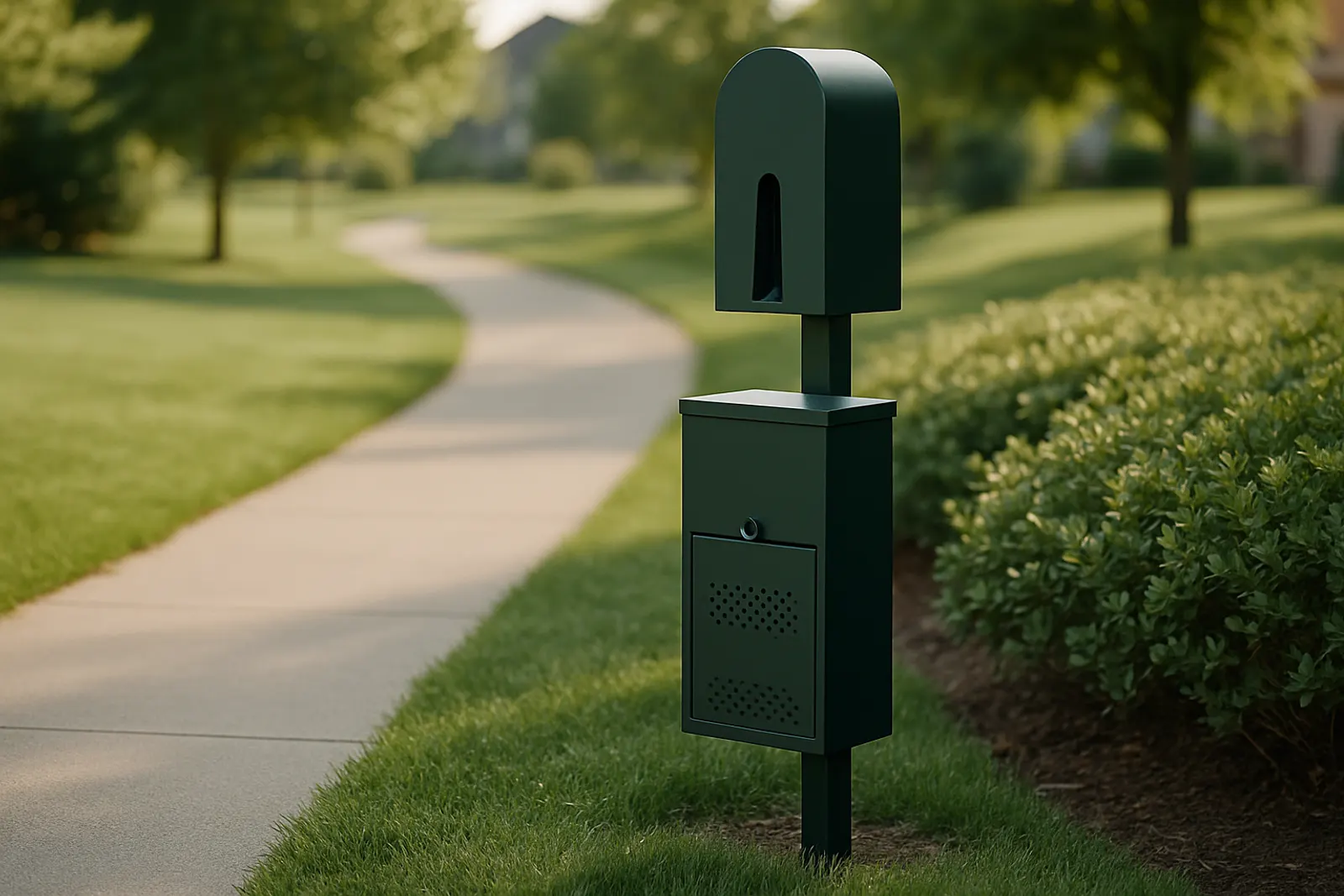
A common working ratio is one pet waste station per 30 to 50 units, or one every 300 to 400 feet along a walking route, with additional stations at entrances and designated relief areas. Placement matters more than ratio — a station residents have to backtrack to will not get used.
Start with the ratio, then throw it away
The per-unit ratio is a useful starting point for budgeting and a poor basis for a final plan. Two 200-unit communities can need very different numbers of stations depending on whether the buildings are clustered around a central green or strung along a half-mile of frontage.
What actually determines the number is walking routes. Map where dogs are actually walked, then place stations along those routes at the intervals above. The unit count tells you roughly what to budget. The site walk tells you where they go.
The placement rules that matter
At decision points, not after them. A station needs to be where a resident realizes they need a bag — near the exit from the building, at the start of the walking loop, at the entrance to the green — not fifty yards along.
Within sight. If a resident cannot see a station from where they are standing, it does not exist. Stations tucked behind landscaping to keep them out of sight of the leasing office get no use at all.
At entrances and relief areas. Every community entrance and every designated pet relief area needs one, regardless of what the ratio says.
Where the problem already is. If there is a stretch of grass that always has waste on it, that is data. Put a station there.
Restocking is the part that fails
This is where most communities lose the benefit of the stations they have already paid for. A resident who reaches for a bag and finds an empty dispenser will try once more. After the second time they stop reaching, and they do not report it — they simply go back to leaving it.
Restocking frequency should be set from measured consumption per station, not a uniform schedule. A busy entrance station in a large community can need weekly restocking while a station at the back of a townhome development goes a month. Servicing both every two weeks means one is always empty and the other is over-serviced.
What this costs a board
Stations plus maintenance are priced per station per visit, which makes the annual figure easy to build and easy to approve. It also makes it simple to add stations later without renegotiating a contract.
For most Southside associations the whole line item is smaller than the cost of the enforcement correspondence and the board time that the problem generates when it is treated as a governance issue instead of a facilities one.
The honest limitation
Stations reduce the problem substantially — most waste left behind is left by people without a bag, not people making a point. They do not eliminate it. Communities that solve this properly pair stations with scheduled scouring of the common turf, so the grass stays clean regardless of resident compliance.
Key takeaways
- Budget on roughly one station per 30–50 units, then place them from a site walk
- One every 300–400 feet along real walking routes, plus entrances and relief areas
- Stations must be at decision points and within sight, or they go unused
- Set restocking frequency from measured per-station consumption, not a uniform schedule
- Stations alone are not enough — pair them with scheduled common-area scouring
We are a pet waste removal service working Southside Indianapolis — Greenwood, Center Grove, Perry Township, Southport, Beech Grove and the rest of the south side. Weekly plans start at $16.99 and there is no contract on any of them.